Life is either a daring adventure, or nothing.
…Helen Keller, from Let Us Have Faith, 1940
This is my shark story.
It’s all true. No part of this story is “based on true events,” as they like to say when fabricating elements of a story-to-be-embellished, or spinning yarns that only have some distant elements of truth. After all, fishermen are known to exaggerate and tell those tales about “the one that got away.”
This story is the true events. I’m sticking with it.
Read on!
Parts of the story below describe the activities of some teenagers crazed by an adventure lust to hunt and kill sharks. I have thought about this a good deal as the years have gone by. These shark events are an unforgettable part of my life. While I have some regrets about participating in parts of these activities, I have made peace with how these activities played out and influenced my life. They were a kind of passion, and involved a mastery of certain edgy skills at a rather young age. They also set a stage, and led into the events of the last little chapter in this saga.
The last time I saw a shark was in April, 1991, at Molokini Crater, out there in the ocean off of Maui, when Jean and I went on a little scuba expedition. Down about 70 feet or so we saw some white tip reef sharks. These sharks were about the laziest sharks I have ever seen. They lie around underneath rocky overhangs and in their little caves. They come out to reconnoiter for an octopus, a slow fish, or some witless crustacean who might be hanging around for shark dinner.
White tip reef sharks have a mechanism of circulating water over their gills, somehow. This is how they oxygenate their lazy fleshly corpuscles while lying around being still in their coral caves. Seeing a still shark was a new thing for me. Other shark species have to keep swimming for a living in order to make the water flow over their gills and get the oxygen necessary for shark life. Swimming all the time! That would be like a human having to walk all the time to circulate air down into its lungs.
Maybe half of the shark brain trades off with the other half to take care of its needs for sleep in order for these working sharks to catch something like a half of a snooze. I know porpoises do this, but I am not really sure if sharks do this, or not. Having to swim all of the time qualifies as “working for a living.” It is shark destiny to have to always be swimming, swimming, swimming, and endlessly swimming on.
But the lazy white tip sharks can’t even get up a little motion, not even enough to come out and give the human scuba spectators a peak, or maybe just even a little swimming-with-the-sharks kind of thrill to tell ’em all about back home.
Creation does require its lazy things, after all. I don’t mind the white tip reef sharks being as they are. I was just making fun. Sometimes I am also about as lazy as a white tip reef shark in my coral cave.
My Shark Hunting Days
It was back in the early 1960s when my older brother Robert and some of his friends took to hunting and chasing sharks on the sandbars in the dicey turbulent breakers of Perdido Pass, Alabama. In those days Perdido Pass was so wild that it could be a treachery to navigate out of Perdido Bay, where our home was, into the wilds of the Pass, and then on out into the deeper waters of the Gulf.
A fascinating array of water creatures darted through its crystal clear emerald green waters. There were shark, sting ray, leopard ray, manta ray, tarpon, porpoise, and all sorts of other fishes of the sea swiftly swimming about all over the expanse of the sandbars which skirted both sides of the turbulent Pass. It was so wild, so beautiful, and always so completely thrilling. And furthermore, I was very young, and impressionable.
To think of this kind of vibrant fish action vs. the lazy, no count, good for nothing white tip reef sharks is just a kind of non sequitur in my thoughts and memories. But I live on with it, nonetheless, for it is part of my shark story. Like I stated, Creation has to have its lazy ones. I know people who could learn to be a little lazier, just for the sake of their health. I used to be one of these types, but I have changed my ways. I now practice a kind of refined laziness, in my coral cave, and I have largely retired from adventurous excitements.
I wish I could recount here how absolutely fabulous and thrilling those waters were, especially for teenager types. It was the perfect place for teenage juvenile daring-do maniacs to exert the projection of their surging inner neurotransmitters (dopamine) and the neurohormones (testosterone) which were in play. That is just a fancy way of saying that we took to acting out our inner chemistry on the rays and the sharks, and some of the other water creatures.
The charter boat captains, who were charged with safely transporting their paying passengers out into the deeper Gulf waters for fishing thrills in their big lumbering wooden boats, complained as a group to the Army Corps of Engineers to do something to calm those treacherous waters so that the Pass could be more easily traversed without those paying passengers vomiting all over their lumbering wooden boats. The Pass also needed dredging from time to time to move sand and deepen the passage so that boats would not run aground on shape shifting sandbars.
And so, the Army Corps came along and constructed gigantic jetties to calm the waters. This did away with the sandbars and the wild breakers. The water creatures, who liked the sandbars as much as we wild teenagers did, had to move on into deeper waters. That was the end of dashing through the breakers for the sandbar thrills. This change in Perdido Pass happened years after I had outgrown the sport and was more deeply involved in my years of schooling.
In the early days of our shark hunting adventures we had a red and white fiberglass “deep V hull” motorboat. Since deep V hulls have little lateral stability it is easy for such boats to be rolled and capsized by overwhelming breaker waves. In 1961 the Boston Whaler boat company introduced a 16’7” cathedral hull in its young line of boats. To circumvent a capsize calamity, our generous and well intentioned mother bought us a 16’7” Boston Whaler. These reliable craft are known for a distinctive cathedral tri-hull. This allowed for a more stable performance in the choppy currents of our watery adventures. This boat always brought us home. And I might add that this Whaler is still in service on Perdido Bay, 62 years later.
With the procurement of this piece of equipment, the hunt was on, and ramped up significantly. No more standing on the skimpy bow of the old deep V in a balancing act and holding on to an anchor or bow line stability rope as the driver, charged to navigate the breakers safely, invariably had the boat lurching and darting this way and that way to outrun or to challenge the breakers head on, as was sometimes necessary to prevent a side rolling and a capsize. The boat’s momentum and trajectory changed by the second depending on the driver’s abilities and reflexes. The driver was actually the main character in these scenarios. The Whaler improved the odds for the hunters, but the sharks and rays held the best odds for the element of water was theirs.
In addition, our mother, the doctor, learned that shark liver extracts were being used in cancer research. Shark liver oil has been used as a remedy for a variety of ailments over time, and is also used as a supplement. The active ingredient is squalene. (One family of sharks is known as squaliformes.) Squalene is an ingredient in one of my skin ointments; used to help the aging skin that used to soak up the sun on those sandbar trysts. Squalene apparently had generated some cancer research interest. Our mother supplied her young troops with the essential hunting implements, and the older boys soon filled a shelf in the freezer with shark liver. But nothing ever came of this frozen shark liver procurement, sadly.
Our mother saw to it that we were well supplied with the requisite equipment that was needed for the hunts: gigs, a harpoon, a crossbow and bolts, and gas and maintenance for the boat. In the fray of breakers and shark chasing madness when a couple of teenagers were armed with such an array of sharp pointed weapons, it is a significant wonder that none of us ever suffered impalement or injury. And our mother never learned about how wild and risky these expeditions really were.
I still have 2 bronze harpoon tips. These are precious relics from the great shark hunts. I kept the crossbow on the wall in my bedroom for years, but finally let go of it as the inner mechanism was completely rusted, the bow string was long gone, and the bow limbs were badly oxidized. The wooden stock was also in rough shape. The bolts were hard to look at, having lost their feathers. Plenty of salt water had gotten to the old crossbow in the course of our adventures. It looked a wreck. But I still have the 2 bronze harpoon tips. I shall pass them on someday to a worthy recipient.
To wield the weighty harpoon and have the strength to drive it through the thick dorsal skin of a very fast moving shark was a true feat. This required the strength of one of the older boys. Once impaled by the harpoon tip, the shark was allowed to run out the many yards of nylon rope and exhaust itself. This dynamic was exactly like the old ways of hunting whales with harpoons, and had no less a sad and tragic ending for the shark.
Somewhere in my collection of pictures I have a picture of a black tip shark and me in the Whaler. I was somewhat responsible for the condition of this shark, which was bigger than I was at that time; me being 12 or 13 years of age. This shark was over 6 feet long. The sharks we captured were 6 to 8 feet in length. There were plenty of bigger sharks that we might chase, but they were too powerful and too elusive for us.
My First Shark Encounter
My first encounter with a shark occurred when I was about 10 years of age. I was imprinted for life. Our next door neighbor on Perdido Bay was our leader and commander, a good hearted older gentleman with a bit of a temper, and some control issues, named Carl. Two of his 3 children were my peers and friends. He liked to take his young troops on exciting fishing adventures in the wild Gulf. The Perdido Pass that he navigated to get us into fishing position was the very same strait of turbulent waters I described above.
Carl seemingly took some relish in skillfully steering his deep V hull boat into the positively wildest breakers he could find and dare. That is where the fish were usually very engaged in carrying on with their fish life and feeding frenzies. That is where the fishing was best. It is also where Carl’s inner psyche became charged with his most special “breakers be damned” way of driving his fishing boat. We loved it.
Usually we had 3 lines out while trolling; one each on the starboard and port sides, and a shorter line out in the middle, off the stern of the boat. In the raucous and turbulent waves, line tangles were rather common; especially if Carl made any sharp turns to get the boat into a more advantageous line of attack, or if he had to escape the effects of very large breakers. Tangles would get Carl to cussing mightily as his young charges listened to the tirade while untangling the tangle. If a reel back-lashed another kind of line tangle would be created, and this elicited an even more excited expressions from Carl. Tangles slowed down or paused the fishing, and Carl did not like such lapses.
If Carl’s hired man help had a moment of freeze (because he couldn’t swim…that would be Leo, Jesse, Melvin, or Cookie), or if the chaos in the boat was too much (as it usually was in the wild breaker scenarios), then the cussing might amplify and might feel more personal. If fish were being rapidly caught, we kids and the hired man had to get them off the hook, stowed in the ice chest, and then get the lines and lures back out quickly for more fish catching. Commander Carl watched all. We were very fast moving feverish young fishers in those fish feeding frenzy moments.
“Are there any lines out?!!!” Carl would loudly exclaim in his most commanding tone. If not, then we might be in for it. We learned to operate as quickly and as efficiently as an obedient kid could possibly do in these chaotic tumults. We were always soaking wet. It was a heck of an adventure for a 10 year old. I would gladly do it again if I could, but only if I could be 10.
My mother used to cuss also when things would wind her up, and so I was accustomed to some of the adults speaking this way. But Carl’s cussing was of another quality because there was the added danger drama in how he dared the waves. I recall plenty of times when the boat was literally on its side and bodies were flying. And there was Carl…cussing on!
He was in the Navy during World War II. It was as if he was trying to work some demons out of himself. He was a kind man underneath all of that noisy bluster. I still love him for everything, and I think of him fondly. I used to watch him watering his azalea garden that was alongside our property. He loved his flowers. I can think of these images of Carl watering his flowers and have a good feeling inside.
We kids never questioned his boat driving tactics. We trusted in Carl, because he always knew what his boat could take. We kids didn’t know, but he did, and that’s all that we really cared about. We knew we were in for some rocking and rolling in these waves where the sharks lived. In Carl we trust, cussing and all! And furthermore, his fishing ventures were the kind of absolute thrill ride that kids love. It was perfect!
I watched out for the breakers as they rolled towards us. I learned which ones to brace for. I became a student of the breakers and how Carl managed them.
There is another element to all this excitement; one of which I am also very fond. These waters, when not all frothed up with breakers and fish feeding frenzies, were absolutely crystal clear and beautiful. While holding my rod and line on my side of the boat while we trolled along I would spend my time peering into the water below the boat. I watched all the wildlife go by.
In those days, the wildlife was very plentiful. Due to increased human presence and activity over time, the wildlife viewing is now a much more meager experience. I would peer constantly into the water and try to identify everything; all of the fishes, the sharks, the various rays, and even an occasional sea turtle. The best sightings were of the manta rays. They were gigantic, as big as the boat was wide, and very fast. Your eyes had to be on cue to catch the glimpse, and register the memory of a very large fast moving black denizen.
It was usually in the breakers where the fish were densely congregated, and cooped up into a feeding frenzy. Hordes of sea birds would be flying all about and dive bombing out of the sky to catch a meal in the waters. In between the incoming breakers, the water could be wildly frothing with bluefish, Spanish mackerel, hardtail, and skipjack. If one’s line was rigged with 2 lures, one might be reeling in 2 fish at a time in these frenzies!
During one such breaker ridden fish feeding frenzy, I was reeling in a catch and had gotten it in close, about 12 feet from the stern. All of a sudden I felt a very hard and sharp tug on the line as I saw a large dark form dart across the frothy boat wake from my right to my left. My pole briskly bent a great deal more than usual, and I was almost pulled over. The hard tug lasted for what seemed a very long stretched out second, and then the line went slack. I almost fell backwards. I kept reeling to see if I still had a lure and if the line had snapped.
To my amazement I reeled in one half of a bleeding hardtail! I had reeled in one half of one of the ones that did not get away. I recall the look on this fish’s face; its body discharging blood and life, shaking in a very hard and violent tremble. In medical parlance a shark had performed a hemi-corpectomy on the hardtail. Eager to get my line back in the water, I quickly tossed my half of the fish into the cooler for Carl’s crab bait collection. That was my first shark encounter. I was 10 years old and wising up to the ways of the wild Gulf waters. I was a 10 year old shark veteran!
Carl had a way with the breakers. We were never capsized by the breakers, but we did take on a lot of water from time to time, and would have to run out from the breakers into deeper water to drain it. It was Carl’s way of driving through the breakers that learned me up to be able to do the same deft boat steering in my own future fishing and shark hunting adventures in the Whaler.
Curiously, we all knew we were in for some excitement on Carl’s fishing trips, and the waves and wildlife did create anticipation and a little trepidation, but no one ever balked. Even the hired men, who could not swim, mustered up into the thrills.
I Become a Shark Hunter
My brother and his older and stronger friends developed their shark hunting techniques over a couple of summers. Eventually I was kindly allowed to come along, sort of in a younger brother observational and apprentice role. It wasn’t long before I had the job of driving the boat, which I got very good at, thanks to imbibing Carl’s exemplary breaker navigational techniques. The driver had to know just how to maneuver the boat in order to put the harpooner or crossbow shooter in the most advantageous position to make an effective shot. This had to be done while keeping an eye out for menacing breakers and warning the man on the bow of an impending difficult wave, and turning the boat to avoid breaker catastrophe while the sharks were out and about.
After studying these breakers in my earlier time in Carl’s fishing expeditions, I became adept at guiding the Whaler through the waves while staying on with the shark chase. We were never capsized by the breakers. When the boat had taken on too much water from breakers crashing all over us, we called off the hunt, drove out to deeper and calmer waters, and drained the boat through the drain hole in the hull. And then, it was back to the hunt.
In all of the excitement, we did our own cursing. Cursing is not the highest use of one’s voice and word. I recall a large banner in the YMCA in Baltimore, Maryland, where I was once a member during my surgery training days in that city…”He knew not what else to say, and so he swore.” Cussing is for people who have forgotten how to express themselves with proper words. From time to time it is also good to go on a silence fast and practice just being quiet.
One of my spiritual teachers once said, “Sweet words scatter joy all around.” This is a very good maxim to live by. I am thinking about a bunch of crazed teenagers speaking some sweet words while pursuing sharks in the wild. Did the whale men of yore speak sweet words while pursuing whales in their whaling rowboats? Just a passing whimsical thought for your consideration. Let’s be clear…we cussed like sailors, all pent up with too much excitement, and needing some way to discharge the excitement.
Aside from being a steady curser, I was also the best spotter of sharks. I had learned to recognize their shadow moving underneath the glare of the waters and waves from a considerable distance. After a number of successful driving roles I became a gig man, stationed on the port side of the Whaler. Then I became a crossbow shooter, also stationed on the left side of the Whaler. The harpooner was on the bow, and was usually my brother’s friend Harris, who had the most strength of any of us and was able to drive the harpoon point through the tough dorsal hide of the shark.
With Harris on the bow, and me on the port side with a loaded crossbow I had to take care to not letting loose with a crossbow bolt in the fray, and injuring Harris. Harris is another of these characters that deserves a little mini chapter. He developed some very aggressive shark hunting ways. Harris went on to have more colorful adventures in his life, such as during his adventures as a helicopter machine gun operator in the Viet Nam war. These shark hunting adventures trained him up for his war time role. We called him “War Daddy.”
I recall one amusing event when we were chasing a shark through breakers where some surfers were having a surfer dude kind of day. A gig was thrown and got away from us in the breakers. We couldn’t find it. Harris surmised, correctly, that the surfer dudes had taken it so that we might go away and not be (arrogantly) chasing sharks in and amongst their surfer dude activities. Harris had me steer the boat around in the breakers while he and my brother went ashore to confront the surfer dudes, who outnumbered them 6 to 2.
Harris, for those who did not know him in those days…well…let’s just say that he might arrive on the scene with an intimidating presence. I watched the scene unfold on the beach while keeping the Whaler copasetic with the waves offshore. The half dozen surfer dudes were surfer dudes who came to an immediate realization as Harris approached. They readily submitted to his inquiry about the whereabouts of our gig. They had buried it in the sand. Harris emerged with the gig. No fisticuff shots were fired! We continued our hunt, perhaps having spoiled the surfer dudes’ day. This is just one Harris story I have. I thought you might enjoy it.
Summers went by in an idyllic camp like fashion on the shores of Perdido Bay over there between Soldier’s Creek and Red Bluff… fishing and shark hunting, shrimping and catching crabs, swimming, water skiing, riding the skipjack, water balloon fighting and mud clay fighting, shooting off fireworks, having beach bonfires, learning about the girls on the beach, enduring dreadful nighttime pranks pulled on the younger boys by the older boys, driving cars on the dirt roads while being several years underage and kicking up dust in our neighbor’s midday soup on his porch, boating and exploring the waterways in the Whaler, the sailboat, the wooden skiff, and the canoe, afternoon naps in the porch hammock, reading comic books, throwing darts, playing ping pong, playing badminton, playing dominoes, playing cards, working jigsaw puzzles, sculpting clay, sitting in the row of 12 rocking chairs on the porch with the adults as they imbibed whiskey and carried on, listening to their version of the world, and so on. There was even the occasional treasure hunt for buried treasures which was orchestrated by the adults, as well as a few haunted house events down at the ancient and fabled Witchwood house with the spooky attic and the (inebriated) spooky adults.
We chewed Bazooka bubblegum when available and we were always barefoot. We had it far better than Tom Sawyer and Huck Finn. Breakfasts were eggs, bacon, pancakes, and grits. Lunch and dinner were wholesome local fresh vegetable based affairs with some kind of protein dish. The washed laundry flapped on the line in the warm summer breezes coming in off the bay. We were usually in motion except for afternoon naps or lazy comic book reading down time before another round of Camp Perdido activity. I don’t recall being bored. Storms and squalls coming off the bay were fabulous, and sometimes fierce. The electricity might go out and out would come the candles and Coleman lanterns if need be.
The only television I remember seeing in all those years was when the Apollo 11 astronauts landed on the moon on July 20, 1969. We didn’t spare much time for TV down there on the shores of Perdido Bay. How times have changed!
The next summer, after my apprenticeship under the older boys, I took over the boat and started conducting my own shark hunts with friends that were my age. We were 14 years old. We were still not quite strong enough to manage the harpoon effectively, but we sure did try.
The harpoon was a 7 foot wooden shaft, 2.5 inches in diameter, with a bronze cone attached onto one end. From this cone a steel rod extended about 1.5 feet. The harpoon point was fitted onto the end of the steel shaft. The point in turn was tethered to a length of 50 yards of ¼ inch nylon rope. When a shark was struck and impaled, it would be allowed to run out the rope until it exhausted itself. It was then pulled in and its life as a shark creature would be over.
This harpoon was best managed by a person with more developed muscles. We were not in that category of athlete. But we sure did try.
My steady shark hunting companions were Henry and Kenan. We were schoolmates from Montgomery, Alabama, where we lived when not cavorting on Perdido Beach during the summer months. For that matter, Henry and Kenan and I were mates since kindergarten days at St. John’s Church in Montgomery. That goes back a ways in our lives. Being good athletes, we also played a lot of football, basketball, and tennis together over the years. I still communicate with them.
Henry and Kenan’s families also had homes on the beach. Kenan was once a participant in one of the wildest and most fascinating fishing stories that ever occurred with the people of Perdido Beach. It involved a deep sea fishing expedition when a manta ray was hooked and reeled in alongside the boat, which was but a modest cabin cruiser. I have always envisioned that the manta ray was as big as the boat, like a sea monster of yore.
I have stored visuals about this story and the sharks that were swimming around the boat and the poor hooked ray. This boat was named the Rak Nat. This is the backwards spelling of Tan Kar, a petroleum company owned by the captain, whose name was Hugh. Hugh was Kenan’s step father. The grown-ups in the boat corroborated Kenan’s manta ray fishing story. If the parts of Perdido Beach where we all lived (Palmetto Creek, Soldier’s Creek, and Red Bluff) had a newsletter publication, this would have been the fishing story of the decade…Rak Nat crew catches massive manta ray! Crazed sharks encircle the boat as the fishermen fight the mighty manta monster!
One sunny summer day Henry and Kenan and I went on a shark hunt. We didn’t capture any sharks, but we had a heck of a time while trying to do so. While wielding the harpoon and trying to master its placement, the harpoon shaft got loose in the water after being unsuccessfully thrown at a shark, and was set adrift in the breakers of the Alabama Point sandbars. In the always ongoing excitement and boat gyrations it happened that whoever was driving the boat managed to run over the harpoon shaft after one of us was unable to grab it out of the water under the bow of the Whaler. With the Whaler on the move, the boat’s propeller cut the harpoon shaft right in two! There we were, with 2 halves of a wooden harpoon shaft.
This damage to what we thought was our most important shark gathering weapon caused a total pause in the action. What to do now? We had no harpoon and had not yet discovered that we really didn’t need it anyway, at least not in the fashion developed in the earlier model of shark hunting technique of the older boys.
Nonetheless, we drove over to Safe Harbor Marina to consult with my favorite boat mechanic, a very affable, wrinkled tan, always accommodating and somewhat grizzled older man named Johnny. Johnny had rescued me from plenty of Whaler boat problems. I presented him with the 2 halves of the wooden harpoon shaft. He produced a segment of lead pipe, which was just made-to-fit-broken-harpoon-shafts. It was as if broken harpoon shafts were a-dime-a-dozen out there on Alabama Point. Happens all the time.
He inserted the broken ends into the pipe till they met, drilled some holes at both ends of the lead pipe, bolted the holes and presented us with a repaired harpoon. It was the only lead-pipe cinch I have ever known. However, the harpoon was now made even heavier by the segment of lead pipe! Such would require an Olympic javelin thrower to wield it with any successful effect. We decided to abandon the harpoon and just set it aside in the Whaler.
But we were happy and satisfied with Johnny’s quick solution and off we went, back to the sandbars. By that point in the day, the sharks had retired from the sandbars, and so we retired also.
Our undaunted trio of 14 year old kids launched another expedition within days. We usually undertook these hunts when the sun was high. This reduced glare produced by an early morning or afternoon sun angle. This day’s tactical plan was to chase the sharks and use the crossbow to slow them down until they could be overcome from exhaustion, and finally captured with a 3 pointed gig. The crossbow bolt arrows were meant to be tethered to some kind of line. We were not that refined. It was just going to be an all out blunt assault with free flying crossbow bolts.
A crossbow bolt is the crossbow arrow, in case you don’t know the terminology. But back in those days, we didn’t know the terminology either. We just called the bolts what they were…arrows. But I thought you might like to know that crossbow arrows are called bolts.
We captured 3 sharks that day. If the Guinness Book of Records had a category for 14 year old teenagers catching sharks, we may have been awarded an entry.
At the time it was all excitement. But it wasn’t long before I abandoned what was really a misguided indulgence of youthful energies.
Why did we pursue and kill these sharks?
Perhaps we hunted sharks because we thought we had to thin out the population of what we thought was a beach boogey creature beast. We should have been fearful of being capsized, losing the boat and the gear, and then being in the water with the boogey beasts. But we were so confident were we in our boat driving skills. Reasonable fear and caution was overruled by some sort of primal response; a rather reckless one that was not informed in any way by caution. It was just a mild form of madness.
The ocean is all a part of us. It is deep and mysterious with beauty and dark forms that lurk in its deep. We are also deep and mysterious with dark forms that lurk in our depths. Were we after these dark forms that lurk in the depths of our being?
In my case I was first informed by the 1956 movie “Moby Dick.” In this movie Captain Ahab, played by Gregory Peck, pursued a gigantic white bull sperm whale through the 7 seas to enact vengeance on the great white leviathan for an earlier encounter when the whale caused Ahab to lose half of a leg. In the climatic moments when Ahab was entangled in harpoon ropes and strapped to Moby Dick’s body by the tangle, he raged on with thrusts of a harpoon into the whale’s body shouting out, “I stab at thee!” Moby Dick had destroyed the whaling boats and smashed many of the ship’s crew with his mighty flukes. Blood was in the water, and so were the sharks! This Technicolor movie visual will not be forgotten…sharks eating whale men in the water! I own a copy of this classic movie. I still watch it and soak in its lessons and messages.
It was the sharks in that scene which impressed me the most and left me with an imprint of their scary savage ways. The long lived limbic system memory I registered is fear. The emotion which resulted 10 years later was more fear, and anger acted out. I was acting out some teenage version of Captain Ahab. Furthermore, I had also learned how to curse when the breakers and the action kindled and sparked in me such a passion and such a kind of expression.
Another great informant of my dark shark emotions was Ernest Hemingway’s novella The Old Man and the Sea. Hemingway wrote this short book in 1950-1951. It was first published in Life magazine in 1952, and helped win him the Nobel Prize in Literature in 1954. The story is about an old fisherman named Santiago who ventures far out into the ocean in his small skiff to break his bad luck spell of not catching a fish for 84 days. He hooks an 18 foot marlin and fights the great fish for 3 days and 3 nights in an engaging contest of wills and perseverance.
The great marlin, once conquered, is lashed to the side of his small boat. Santiago heads back to shore. Along the way the marlin is eaten by sharks. Santiago battles the sharks, but to no avail. He arrives back ashore with the skeleton of the great marlin tied to his boat. The life lessons portrayed in this simple story are truly great ones; ones which were told simply by an old fisherman. At the time I read it, which was during my shark hunting days, the imagery of the sharks taking away Santiago’s prize was greater than the many life lessons which I was still too young and undeveloped to grasp.
And then there was the television series Sea Hunt, starring Lloyd Bridges as former Navy diver and adventurous hero Mike Nelson, airing weekly from 1958 to 1961. I saw dozens of the episodes which featured an array of well known actors. Of course, another notable actor who frequented the series was some variety of menacing shark.
There were also a few older people on Perdido beach who had some fearful encounters with sharks that were told as part of the legend of the beach. These stories also registered, and mixed into the inner milieu of this young Ahab, and into my memories of the trials and tribulations of Santiago.
The third shark we captured that day presented a lot more excitement than the other 2. This shark took us on quite a sandbar chase. The driver was charged with herding the shark back into the shallow waters should it try to escape off of the sandbar into deeper waters. This particular shark had plenty of energy for the chase and the fight. I put 3 arrows into the shark, and it was still going strong. I was out of arrows at this point, but we were coming up on an arrow floating in the water. I can grab it!
In a true moment of mild insanity, and while totally misjudging the depth of the water, I hopped out of the boat and grabbed the arrow in a nicely executed move. My intention was to simply bounce off the sandy bottom and hop back into the Whaler which I still had a hand on. However, having misjudged the water’s depth, I was in up to my chest. I would not be hopping out of this depth back into the boat! The Whaler slipped away.
To intensify this little drama, Henry was taken by surprise by my unannounced swim. As he turned the Whaler to come back for me, the shark turned back faster than Henry and the Whaler, and was now headed straight toward me! The visual that I recall all too clearly was a 7 foot black tip shark with 3 arrows sticking out of it heading straight for me. This stunning visual was matched by the look on Henry’s face as he commenced to turn the boat around to rescue me.
I have always remembered this look of “high concern” (panic) on Henry’s face, framed by his bright red hair and the blue sky. It was one of those looks of high excitement and fear, all framed up, as stated. Of course, in order for me to focus on Henry’s face and remember it so clearly time had to slow down almost to a stop. An exciting moment for a 14 year old, to be sure.
I was chest deep in the crystal drink holding a crossbow arrow, or bolt, as the case may be, and while I was observing Henry’s look, I was registering a few fast thoughts about how I might use the arrow to defend myself from a wild and wounded creature beast with its layered rows of very very sharp teeth…the very bloodied beast that I had taught myself to fear and hate in the few years of my young life!
The words of Captain Ahab “I stab at thee” did not cross my mind at that moment in my life, but I prepared myself to use the arrow in just such a way, nonetheless. In a matter of some very long moments Henry got closer, and so did the shark. The shark got right up to me, within 3 feet…an arm’s reach!…and then quickly turned away as the boat approached. It was in its throes of its final fight flight panic when the sight of me in front of it, and the boat closing in behind caused it to turn away.
Finding myself back in the boat after these few moments of unnecessary manufactured excitement, I thanked my red haired savior who was always a very athletic fellow, and especially so in those few exciting moments. We chalked this diversion up to ordinary shark hunting action by teenagers. This activity was becoming who we were down there in those summer days on Perdido Bay.
We looked around for the shark. It had disappeared from sight and slipped off of the bar. We drove around looking for our wounded prey. After minutes of this…nothing. We would have to chalk it up as “the one that got away.” We could have a future fish tale to spin…massive shark eludes capture and escapes with 3 arrows, almost attacks one of its captors…the biggest and scariest shark ever seen off Alabama Point! Hair raising moments of wild panic in the breakers!
And there we were, puttering over the sandbar just wondering what to do next…keep hunting, or go home with 2 sharks and a tale of a third, when all of a sudden Kenan noticed a group of half a dozen people on a stretch of the beach beside a deep channel at the edge of our sandbar. They were excitedly clamoring and carrying on about something they had discovered on the beach which clearly had captivated their interests and excited their bodies and undoubtedly their voices as well.
It was our 3 arrowed shark! In its exhaustion, confusion, and frightened dying moments, the shark had beached itself some 50 yards away from where we had hunted it.
We hastily drove over to claim our shark. We put to authenticating ourselves with these grown-ups and helped them understand that we, yes, we young teenagers, were claiming this shark and that they could calm down and carry on again with their mature beach activities. “Nothing to see here” was the basic theme of our explanations. “Don’t worry, we will take it from here. You can move along now. Nothing to see…just a dying shark impaled with arrows. We do this all the time out here…And, have a nice day!”
We didn’t really say those words. We were, after all, 3 kids who respected their elders and knew how to say “Yes sir, no sir, yes ma’am, no ma’am.” We were good little southern boys when the grown-ups were around. I wouldn’t have it any other way, let me tell you. We were reared correctly!
I really cannot remember exactly how we explained to these grown-ups our relationship with this poor shark. Perhaps they had seen us out in the Whaler darting about in the breakers and made the association that we were responsible for this creature’s state, and its suffering.
The more I think about this shark, the more I have empathy for all living things; man and beast alike. I had learned to fear and hate the sharks. This unfortunate prejudice and bias was largely unfounded, for the sharks had never hurt me or anyone I knew. I had not been taught and conditioned to love the shark as a member of God’s creation. People don’t tend to think of sharks like that. This is the lesson. I was living in a fearful dualism, one born from ignorance.
I harvested the shark’s jaws and kept them for years. It was a beautiful display of shark cartilage anatomy, and razor sharp very pointed saw like teeth, set 7 rows deep! It was quite a stunning hunting trophy. But it started to change me. Some 20 years later I gave it to a school teacher in Florida who used it in some manner as an interesting prop in his school teaching about God’s sea creatures.
And so it went with the other 2 sharks we killed that day. The jaws were harvested, and the shark’s body was given back to the deep. All of this was for our thrill and entertainment. Hunters are often like this; uncaring and careless. It would have been a total waste for me except for my internal doubt and lament, and subsequent growing spiritual insights about Creation and its creatures.
Forgiveness is the only way we heal. All of the foibles and folly of one’s life should be forgiven to be best of one’s ability. Then the healing can happen. I am still learning to love all of my life while forgiving and retiring the less than admirable things.
This series of exciting teenage thrills and adventures marked the end of my brief shark hunting chapter. After this I kept to fishing for King mackerel in deep waters, and Spanish mackerel and bluefish in the shallow waters. These fish were never wasted. I became adept at serving mackerel filets steeped in a lemon butter sauce and smoked on a grill with fresh hickory branches soaked in water. And mackerel roe was one of my personal favorite treats. The cleaned carcasses were used for bait in crab traps out on Carl’s long pier. This was my earliest recycling effort. “Use it up, wear it out, make it do, or do without.” I have always tried to live by this resourceful Yankee jingle.
From time to time I would revisit the sandbars while they were still there, and I might come upon and chase a school of tarpon who were sunning in the shallows, but only for the chase and the chance to just see them swim in the crystal waters in their elegant beauty and speed. These great and beautiful fish were not to be harassed and taken by a bunch of lads wielding pointed things. They swam in orders of magnitude and power more deftly than the sharks. I was their student whenever I could attend their rarely given class. These days in my memory of their silver speed and shining beauty, I am able to attend that class pretty much whenever I want.
Now it is time to tell you about an event that all of these shark encounters led up to.
A Big Bite
Every day is a new day. It is better to be lucky. But I would rather be exact. Then when luck comes you are ready.
…Santiago, in The Old Man and the Sea, by Ernest Hemingway, 1952
This title of this end chapter is not exactly a great one, but it will have to do because it is also the truth. I’m sticking with it.
This chapter deserves some preliminary remarks about great physicians who played an important role in my life, and in aspects of this experience. I owe these physicians much. Read on!
This little chapter portrays a time in the summer of 1975. This was the summer that the hit movie “Jaws” came out. Released in theaters in June, 1975, this summer blockbuster movie absolutely captivated the American, and global, public. It was an instant classic. My wife and I still watch it every 4th of July, and while I watch it just one more time, I have a little cascading reverie of memories. This summer of 2025 marks the 50th anniversary of “Jaws.”
My shark hunting chapter had ended when I was 14. Ten years later “Jaws” came out. I had just ended my second year of study at Tulane Medical School. Finding myself between my sophomore and junior years of medical school I put immediate attention to securing some kind of clinically oriented job for that summer.
The first 2 years of medical school are devoted to a study of the “basic sciences.” These are subjects such as anatomy, pathology, physiology, biochemistry, pharmacology, microbiology, and so on. The second 2 years of medical school are devoted to the clinical sciences and developing rudimentary knowledge and skills in their application. Such course work includes medicine, surgery, pediatrics, obstetrics and gynecology, and psychiatry in the third year. In the fourth year we Tulane students pursued a more creative tour through an array of elective courses of our choosing to help orient us into a deeper consideration and study of what field of medicine we might be committing ourselves to after graduation, which was coming up within a year’s time. Upon graduating at the end of the fourth year, we began residency training in a teaching hospital in our chosen field of doctoring.
With medical school graduation 2 years away in that summer of 1975, I did not have any kind of clear feeling or inclination as to what kind of doctoring I wanted to apply myself to. My mother was an internist and my father had been a general surgeon. My father passed on when I was a senior in high school. My parents met in the Tulane residency training programs of Charity Hospital in New Orleans.

Their most notable professor was the renowned Alton Ochsner, M.D., who was chairman of the Department of Surgery at Tulane. Dr. Ochsner is regarded as one of the world’s all-time great surgeons. He established the link between smoking and lung cancer which is one example of his many noteworthy contributions. He was president of the American College of Surgeons (seen here in his ACS robes), and he founded the Ochsner Clinic in New Orleans where I did much of my 3rd and 4th year medical school study. I knew Dr. Ochsner briefly. I only wish I got to know him better.
In pre World War II years Dr. Ochsner’s surgical residency training program at Tulane and Charity Hospital was highly desirable, and was sought after by young doctors seeking the best surgical training. Others who trained alongside my parents included Dr. Michael DeBakey, and his younger brother Dr. Ernest DeBakey. The older DeBakey became the very world famous heart surgeon and Chairman of Surgery at Baylor Medical School. The younger DeBakey became an acclaimed general surgeon who practiced in Mobile, Alabama for his whole career.
From our home on Perdido Bay, going about 20 miles west down Highway 98 in south Baldwin County, Alabama, one comes to the city of Foley, Alabama. I had visited Foley many times over the course of my life on Perdido Bay. I often bought new comic books to read at Wright’s Drug Store. I might visit the fish market for those kinds of goods, as needed. We might visit a farmer’s market for vegetables. I once had an infection on my left leg which was treated by one of the doctors in Foley.
The good people of Foley at that time were mostly agriculturally based. Foley has grown from a city of 5000 people in the 1960s to 20,000 people today. A good deal of this growth is due to tourism industry growth resulting from the proximity of Foley to the Gulf beaches where I had those fishing and shark experiences described above. Foley has a good school system, and a nice library. In my post surgery career as a health consultant I gave a few lecture presentations in Foley.
Foley peoples’ medical needs came by way of some general practitioners who offered their services at South Baldwin Hospital. One of those general medical practitioners was Dr. Marvin Taylor. I had heard about Dr. Taylor all along the way, but I had never met him. As I approached that summer break from medical school in 1975, it occurred to me that I might try to secure some sort of position at South Baldwin Hospital, work with Dr. Taylor, learn a lot, and maybe get some inkling of what kind of doctoring I wanted to practice…all while staying over on Perdido Bay.
I applied to the hospital director and Dr. Taylor, and I was approved to serve as an intern in the Emergency Department and in surgery. Dr. Taylor would be my supervisor and teacher. He and my mother knew of each other, and that surely helped me land this position. This is one of the most fortunate milestone marks in my medical career. I owe much to Dr. Marvin Taylor.
To those who knew him it is not necessary to recount his amazing and delightful human qualities and personality, and his physicianship acumen and mastery. Others may learn that this colorful country doctor was arguably one of the most brilliant and skilled practitioners of his era. He was hailed, loved, and revered by his patients, and many friends. He ranks alongside my mother as a large hearted and highly adept practitioner. Both of these doctors were honor society awardees of Phi Beta Kappa in college, and Alpha Omega Alpha in medical school.
But such academic brilliance truly pales away when one considers their life work offering which saved and enhanced the lives of thousands of people in Alabama, and beyond. I think of my mother and Dr. Taylor as the best physicians I have known. The two physicians never met each other, but they knew of each other, and I heard each of them express their respect; one for the other. I was very fortunate to have them as physician exemplars of the best qualities of physicianship.
And there was another great physician who I rank with them, and also had the immense good fortune to have as a mentor and friend. This is none other than Ernie DeBakey, MD, who I also met and apprenticed under at South Baldwin Hospital. Ernie was a highly regarded general surgeon. His practice was in Mobile, Alabama, 40 miles west of Foley. Ernie came over to Foley on a weekly basis to do the more complex surgeries that Marvin was not trained to do as a family practitioner. This included all large abdominal surgeries, thyroid surgeries, and breast surgeries. Many of these procedures would be for cancer. Marvin was the primary doctor who would work his patient’s problems up into a diagnosis that Ernie would be called upon to fix.
I have met and tutored under many fine surgeons in my life. There was none quite like Ernie for efficiency, speed, and definitive resolution of whatever the problem might be that he was called upon to help. In the cases which he performed for Marvin, I was allowed to scrub in as the second assistant while Marvin was the first assistant. This experience for me was revelatory. I watched and learned from a great surgical master in that summer of 1975. It would be challenging to catalogue all of the kinds of things I learned from being with Ernie. Many of these things are intangible physician qualities.
Was I beginning to warm up to the idea of becoming a surgeon? This query began to circulate in my thinking as those days with Marvin and Ernie unfolded.
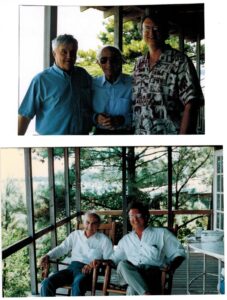 I had never been in surgery before those summer days of my experiences with Marvin and Ernie in the operating rooms of South Baldwin Hospital. Therefore, I had no frame of reference in which I might compare one surgeon’s skill to Ernie’s skill, and even to Marvin’s skill in the surgeries he performed. Nevertheless, I could see how Ernie’s hands worked to create the result. There was no wasted motion. There were no kinds of clumsiness or moments of doubt. His hands were always moving with a purpose. In short, his surgeries were a sort of fast moving elegant blaze of mastery. Whenever I think of the greatest master surgeon I have ever known, or known about, I think of Dr. Ernest DeBakey.
I’ll never forget the time when he had me first assist him on a patient’s thyroid surgery. This was towards the end of my summer internship with Marvin and Ernie and the fabulous Operating Room crew at South Baldwin Hospital. I went on from this summer of learning to become a very good surgeon in all of the types of surgery which I watched Ernie perform with Marvin that summer. I owe much of my success as a surgeon to these 2 great physicians.
(At left…these 2 pictures of Marvin, Ernie, and me were taken in 1993 and 1997 at Marvin’s home at Bon Secour, Alabama. In the top photo Marvin is 60, Ernie is 81, and their former apprentice is 42.)
The staff and personnel of South Baldwin Hospital were a warm and friendly group of people. I was closest to the OR personnel. I enjoyed their country folk ways and the way they poked fun at Marvin and Ernie on a daily basis. They worked well as an adhesive group. I also enjoyed knowing other members of the hospital staff. I’ll never forget the night a group of us younger hospital folk got together for a night out over in Pensacola, Florida to dine at a kabuki steak house and then go to the movie “Jaws” which had just come out.
My first viewing of “Jaws” was a memorable one. The best line in the movie was when actor Roy Scheider’s character looked at Jaws face to face as he was chumming fish bait off the stern of the boat. Jaws suddenly emerged out of the deep and came within a few feet of Sheriff Martin Brody. The face of the shark seemed to fill up most of the screen. Everyone in the theater probably gasped and clutched at something. It still gets me when Jaws’ face blows up like that in my annual re-viewings of this movie. Chief Brody told Robert Shaw’s character, the professional shark hunter Quint, “You’re going to need a bigger boat.” Jaws was cited in the movie by Captain Quint as being a 25 foot, 3 ton great white shark. Quint’s modest rickety cabin cruiser was no match for this behemoth denizen of the deep.
One afternoon in mid June, 1975, right as “Jaws” was hitting the theaters, I reported to the hospital Emergency Department for my shift. One of the older nurses in the department rushed up to me in a state of great excitement. She grabbed my arm and said, “Quick John!…go to the OR!…Dr. Taylor is operating on a shark bite!”
Marvin was actually operating on a man who had been afflicted with a shark bite. OR people tend to speak like that without meaning to depersonalize the issues at hand.
I registered this message in a flash. It caused me to have a rush of blood to all of the parts of me that helped me move quickly into the dressing room and on to the scrub sink station and into the OR where Marvin was holding forth. All of a sudden, I was back in the hunt, riding the Whaler through those breakers!
The individual who had been visited by a rather large shark was a local person who was out fishing in his small wooden boat, about 5 miles offshore. His was a simple boat with no cabin, no steering console, no covering; it was just a simple open boat with an outboard motor on the stern. The man was with his wife. They found themselves in the midst of a large school of King Mackerel and bonito which were busily feeding in a sort of big fish feeding frenzy. Circling all about this fish feeding event was a number of large charter boats with their avid fisher passengers.
I have been in many of these types of big fish feeding frenzies which happen far offshore. I recall the images of many large charter boats circling the school of fish to capitalize on the fish activity and claim their catches. As a driver of the Whaler in these circumstances, I would have to be careful that I did not troll too close to these other boats. Fishing line tangles with other boats’ lines is a problem; as is running over another boat’s lines and getting them entangled in the propeller. I always kept my distance from the unforgiving bossy charter boats.
But back to our story of our fisher man in his open boat! As fisher man told the story…in the midst of this excited fishing activity, he developed an urge to defecate. Rather than just parking his butt over the side of his boat to relieve himself, and have everyone on the charter boats see him do that, he decided to jump in the water, and relieve himself while floating alongside his boat. Being a modest local fellow and perhaps not wishing to offend the uppity charter boat people in any way, he executed his decision to jump into the deep drink and relax his bowels.
This decision resulted in a series of exciting events, as you have surmised by now.
In a school of large fish which are feeding on smaller fish there is a certainty that in this pecking order of fishes there is going to be a larger fish than those large fish which are feeding on the smaller fish.
One such large fish in our story was a rather large shark that may have been attracted to a certain odor in the water, or may have been curious to determine what one of the dangling legs of the fisher man might taste like, but probably both things were calling the shark. And so, the large shark wrapped his large jaws around one of fisher man’s legs behind a knee joint. The shark bit and let go without twisting or tearing at fisher man’s leg. Fortunate was this kind of shark biting vs. the type when the shark bites, holds on, and starts twisting its body to tear off large amounts of flesh. In this case, the fisher man would have surely lost his leg at the knee, and perhaps his life also.
The fisher man knew he was in trouble and got back to his boat with haste. He made it back into his boat. Meanwhile the shark had decided that the fisher man’s leg offered an appealing appetizer, and shark came back to the table for second helpings. But the fisher man was now in his boat. Nonetheless, the shark came back around and struck at the boat. A chunk of wood came off in the bite.
But thankfully the shark did not damage the hull of the boat such that the boat was not seaworthy enough for a mad dash back to shore. Otherwise, the fisher man and his wife might not have been able to get to shore in a safe fashion. They would have had to hail a lumbering charter boat for assistance and ruin the charter boat paying passengers’ fishing jubilee.
The wife wrapped up the leg with its bleeding wound in a towel and they made what must have been a frantic dash for shore over that distance of about 5 miles. That dash, in and of itself, is a respectable feat. I wish I could have seen some of that. I have made many such dashes over the waves into the shore from out in the deep; not because anyone was in trouble, but because the Whaler afforded an exciting flight over the waves. We became airborne off the crest of many waves. I wonder if fisher man’s boat became airborne as he raced to shore in a bouncy ride with his injured leg.
Upon being transported into all of the open arms at South Baldwin Hospital, Doctor Number One was called. Dr. Number One is how Marvin was known in the hospital and was how he was addressed when called over the hospital intercom whenever he was needed somewhere. He was also known to us in the OR as “Super.”
Indeed, Marvin was Doctor Number One, and he was also Super. Fisher man was in the best of hands that June afternoon. Dr. Number One was there with his healing ways…and his young assistant…me!
I scrubbed up and entered the OR to find fisher man under general anesthesia, lying prone on his belly, the left leg prepped out displaying a perfect bite pattern of multiple lacerations in an oblong circle pattern surrounding the knee joint; above on the lower thigh and below on the upper calf. At maximum length the diameter of the bite pattern was over 12 inches. The shark, having just bit and let go, did not leave the leg with too many jagged lacerations, but there still were quite a few of those kinds of cuts. There were a few deeper and more complex lacerations, but the majority of bites were simple and uncomplicated. Some lacerations were short and somewhat punctate, with most being 1 to 2 inches in length.
Most fortunately for the patient, there was no damage to the popliteal neurovascular bundle and there was no damage to any of the tendons. The joint space itself was not violated. These were clean wounds, each displaying good blood supply and requiring very little debridement of devitalized tissue.
A 12 inch bite radius indicates that this shark was at least 12 feet in length. It was as long as fisher man’s boat! That line from “Jaws” is appropriate to remember here…“You’re going to need a bigger boat.” But fisher man’s boat served him well in this adventure. It got him to shore!
Being scrubbed in and wanting something useful to do in this surgery, Marvin immediately encouraged me to take up a needle driver, suture, and forceps and start suturing. I had never sutured before, and so with some expected clumsiness I oriented my hands and their motions to this opportunity to suture, and to help make right the delicate cells of creation of fisher man’s ravaged leg. Marvin guided me through a few correct movements, needle placements, and knot tying. The jagged lacerations gave me the challenge of lining up edges of flesh so that they matched and were not too tightly reapproximated.
And so it went with my first experience as an apprentice surgeon. I got the hang of simple suturing and got a little better as we methodically moved through the dozens of shark bite lacerations. Marvin taught me how to instrument tie the sutures, and how to tie with 2 hands as well as how to tie with the surgeon’s one-handed technique. I would spend the rest of that summer practicing tying knots with one hand, and also with the needle driver looping technique.
While scrubbed in on Marvin and Ernie’s surgeries I could feel myself being pulled in to the craft and art of surgery. Fisher man’s shark bite wound help initiate me into a calling. There was no doubt that surgery was calling me, and I would become a surgeon. The rest of my time at Tulane Medical School helped me orient more closely with this decision.
Shark bite fisher man was a big story in the press. Because of the “Jaws” movie sensation, journalists were calling in to speak with Super from as far away as Australia. And after a few days of healing and great nursing care, fisher man (name withheld), age 27, was discharged from the hospital. He had no infection in his many wounds. Marvin had told me that the salt concentration in the Gulf water prevented any complicating bacterial contamination and festering.
Super always seemed to know these kinds of earthy facts, and he exercised them on me like a professor. My future professors did not cast such earthy pearls like Marvin did. Too bad. Maybe they didn’t know any earthy pearls of common sense wisdom to cast. It is possible that my surgery professors knew some earthy wisdom pearls, but they were professors, after all, and keeping the stricter status quo might be more professorial. But not Marvin…Super was out there in the countryside trenches duking it out with pain and suffering!
I had a few good surgery professors, but they weren’t Marvin and Ernie. This pair of physicians could not be matched for their all around excellence and how they showed up inside of every situation that I was lucky to observe.
Post op fisher man’s wounds looked very clean. I did not see him leave the hospital, and so I do not know if he walked out on crutches, or was escorted out in a wheelchair. He had what we call “a very good result,” especially in consideration of how devastating this injury could have been.
That excitement and drama, and my small role in it, occurred 50 years ago. That summer of 1975 was one of the most colorful, exciting, and formative times of my life. I was 24 years old. I now wish that I had kept some sort of diary of all of the things I experienced with Marvin and Ernie in that hospital, and all of the things I was exposed to and was taught.
If all of those charter boats and charter boat fishing people had not been circling the big fish feeding frenzy, fisher man might not have jumped in the water to relieve his bowels. He would not have been visited by a very big shark. I wouldn’t have such a shark story to tell you.
Would I have become a surgeon? Most undoubtedly the answer is “yes, I would have become a surgeon.” Marvin and Ernie drew me in with their great physicianship and skill.
And I am thankful that the nature of fisher man’s superficial wounds allowed him to not bleed out and die during that dash back to shore. Indeed, I am thankful for God’s web of life…from sharks and fish feeding frenzies to charter boats bloated with fisher people and to desperate dashes over all of the mighty waves that life keeps sending our way.
All surgeons learn to suture somewhere, in some way, on some patient who has come to need the surgeon’s help. In future years when I was working on as a board certified surgeon in a large medical group, one of my OBGYN partners used to say, “The whole world is pre op.” There will always be a need for surgeons and their craft.
Just a few months ago I sutured a rather large laceration on a friend’s scalp. He sat at my dining room table for the procedure, with blood running down his face, as his teenage daughter watched the proceedings. This old style homespun way of patching up peoples’ wounds is very “Marvin-esqe”. This event took me back to my first sutures in shark bite fisher man’s leg 50 years ago. After her father’s scalp was put back in order, she wanted to learn about suturing. I pulled out some styrofoam padding and used the same instruments to teach her how to place sutures and tie knots using this padding in place of wounded flesh. I sent her home with the suturing instruments and some suture and the styrofoam to practice with.
In our surgery residency training program we used to say, “See one, do one, teach one.” In those years of surgery training I had the opportunity to teach and pass on to surgeons who were younger than me some of the skillful ways of Marvin and Ernie.
Ending Words
This is the end of My Shark Story. It is a little story about some events in my life which helped propel me forward through the breakers and sometimes frothy waters of my life, and on to the gentler waves that wash over one in the calmer waters.
I learned lessons about the web of life which carries itself forward on our little blue-green planet, and which allows so much life to coexist in the unfathomable expanse of God’s Glory.
I often recall Samuel Taylor Coleridge’s poem “The Rime of the Ancient Mariner.” In this epic poem the story is told of a sailor (a mariner) who shot an albatross with his crossbow. After this event the ship and ship’s crew fell victim to a string of very unlucky events. The crew made the mariner wear the dead albatross around his neck as punishment. He was made to endure his own hardships as the crew endured theirs.
As penance for shooting the albatross, and being driven by his guilt, the mariner was compelled to wander and tell his story again and again, attempting to teach his lesson to those he meets. He told his story to a person who was traveling to a wedding. He had to captivate the wedding guest who resisted hearing the old man at first, but soon the wedding guest was drawn beyond fear and suspicion into fascination as the mariner spun his tale.
In the end, the mariner said:
“He prayeth well, who loveth well both man and bird and beast.
He prayeth best, who loveth best all things both great and small.
For the dear God who loveth us, He made and loveth all.”
I believe that the Ancient Mariner was destined to endure the many rigors and hardships of the voyage of his life so that he could learn how to tell his story about coming to a repentant and prayerful life.
Thanks for reading.
August 8, 2025
More Reading
Remembering my friend Carl W. Bear (1913-1993)..Carl was an attorney in Montgomery, AL, and was also a managing owner with his brothers of Bear Lumber Company. He designed and contracted for the construction of our family home in Montgomery and our home on Perdido Bay; the latter of which has survived a few hurricanes. Carl’s wife Virginia and his oldest son Carl, Jr. preceded him in death. His son Tommy and daughter Gypsie carry on with us, as do 5 granddaughters and 2 grandsons. I used to visit Carl to discuss things and muse over the football team we cheered for. He wrote me a very generous letter of recommendation when I was applying to medical schools. As my father was largely absent in my life, I received fatherly influences from a number older men in my life. Carl was one of those men. Perhaps I will have another boat ride through the breakers with Carl and Leo, somewhere in a future place and time.
- Marvin Taylor’s obituary…the picture of this wise and mirthful man says it all.
- Ernest DeBakey obituary…a nice little tribute to the man and the physician.
- Ernest DeBakey Charitable Foundation…Ernie was a warm kindhearted surgeon who served so many people. This picture of him is the picture of a kind hearted man who was also a blazing dynamo of a surgeon. He laughed and joked with me constantly, and became serious when the moment called for that.
- Alton Ochsner, M.D.…the teacher of Ernie DeBakey and my parents. I once attended one of his very famous “bull pen” sessions in the Delgado Amphitheater at Charity Hospital when I was a medical student. I haven’t forgotten. Perhaps I can call myself a student of Dr. Ochsner. Ernie said, “he was a superman.” He was truly revered. His bull pen sessions were of historical significance.
- Mention of Shark Man’s event on the web…indeed, he was swimming. His name is not given here, and so confidentiality is maintained.
- Lulu’s Law…The United States Senate passed Lulu’s Law on 7-9-25 to establish a shark attack warning system after Lulu Gibbon was attacked by a shark in Alabama, lost her left hand and part of her right leg just 45 minutes after a woman down the beach lost her hand to a shark, perhaps the same shark.
- Woman looks into clear waters of Alabama beach–then sees what’s lurking…a 9-9-25 notice of sharks swimming in the shallows at Orange Beach, AL, where we used to hunt sharks.
- Shark spotted hunting near Perdido Key shoreline…This shark shows us its forward dorsal fin and also its tail fin as it chases a ray very close to shore, like where people bath and swim. This shark is a 12-14 foot shark. There have been many shark attacks over the years, and they are becoming more frequent. Most shark attacks happen in shallow water. Regarding seeing a shark fin cruising through the water: one should become a bit worried and concerned when one first sees the fin. If the shark fin then disappears one should become very worried and very concerned. Where did that shark fin go and where is that shark?
- Hammerhead sharks swim near Perdido Pass bridge in Orange Beach… This is Perdido Pass, now made calm by the rock jetties. The throng of boats leisurely anchored all around would never have been seen in the old days. The bridge marks the boundary between Perdido Bay (beyond the bridge) and the Gulf (this side of the bridge in the picture). The waters are clear in this video, like they used to be. These sharks are the size of the black tip shark which we pursued in our shark hunting days.
- Wild Shark Recognizes Human Best Friend After They Were Separated For A Year…a 3.5 minute video documentary about an affectionate tiger shark. This is an appealing look at these creatures of the deep.
- Fishing in Perdido Pass…Some of the kinds of fishes we used to catch. All of the hotels and condos were not present back in the day. It was wild and pristine except for a few beach houses and some marinas tucked back up in the bayous on the bay side of the bridge.
- Perdido Pass history…neat old pictures of how things were back when. This article describes some of the kind of history that we Perdido Bay people love to read.
- Perdido Pass…the Wikipedia version.
- The Rime of the Ancient Mariner…all 625 lines of this beautiful story.
- The Old Man and the Sea…52 meaningful life quotes from the great novella of 26,531 words by Nobel Laureate Ernest Hemingway, written in 1950-51. This beautiful story is a true spiritual story. I think everyone should read it. I read it when I was a young shark hunter. Sharks are a main character in this incredible story about human perseverance, hope, faith, humility, nature, and other great themes, such as ones seen here in this link.