This Journal describes the book that stimulated my 5th grade intellect on the amazing workings of the human body.
My 5th grade teacher tasked everyone in the class to deliver an oral report on some subject of our choosing. I decided to do a report on the human body. Here is a report of that report, some 65 years later, and some praise for a special book.
In the Fall of 1961 I attended Bear Elementary School in my home town of Montgomery, Alabama. The school is named for my friend Carl W. Bear, who is one of the main characters described in My Shark Story. Bear School is still a going concern.
I had not yet studied any material on the human body, but since I was living in a human body, I thought it might be a good subject to get entangled with at age 10, and develop some understanding of what I was dealing with, and so I created my report based on all of that. My physician mother did not directly participate in my decision or in the preparation of my report. However, she had given my older brother Robert a copy of a very special book, published in 1959, entitled The Human Body, What It Is And How It Works, and so she did participate in a very necessary way.
Published by Golden Press, this text was nicely authored by Mitchell Wilson and illustrated beautifully by Cornelius De Witt, aided by Arthur W. Seligmann, M.D. as medical consultant. I appreciate these authors and publisher, to be sure. Furthermore, the paper of the pages is of a nice thickness to handle. The pages won’t tear easily when in the hands of youngsters who might not turn the pages with care.
I latched on to this book to aid my report. It was prime source material for the assignment. I was readily fascinated with the colorful artwork and descriptions which filled every page. This book has been in my possession ever since. Later on my brother Robert approved of my “permanent loan” acquisition from the bookcase in his room.
I delved into the book to see what I might be able to come up with for my report. I explored 140 pages with over 200 beautifully hand drawn images. As fascinating as all this was to my curious mind, it was almost too much to handle. How was I to condense all of this information into a 5-10 minute report for my class and teacher?
The trusty book solved the dilemma for me. On pages 17, 18, and 19 there are very handy pictures and descriptions of The Nine Systems of the human body; namely, the skeletal, muscle, nervous, digestive, respiratory, circulatory, lymphatic, endocrine, and reproductive systems. (See the description in the article below.)
Presto! Each system was briefly described in a half dozen sentences. All I had to do was make some condensed notes about each system on some 3 X 5 inch index cards and I would have a nice summary for my class and teacher of what the human body is and how it works. And that’s what I did. Overcoming some stage fright, I delivered my report on “The Human Body.” Classmates and teacher gave me favorable reviews.
Our 5th grade teacher, Mrs. Viola B. McInnis, added an extra dimension to our report efforts by recording each report on a vintage reel to reel tape recorder which my mother loaned her for this purpose. My mother used this large box-like recorder in her home office to record chart notes and letters to and about the patients she had seen that day in her office, in the hospitals, or on house calls.
The playback of my report left me a bit surprised, and a little self conscious, about what my voice sounded like. Up to that point in my development self awareness had not been much of an inquiry for me. My teacher gave me an A grade for the effort, and marked on my report card, “John’s recorded talk was very good.”
This was my first study of the human body. I’ll never forget this, mostly because of the book which aided my report.
The Marginalian
Recently a family member sent me a link to an interesting website, The Marginalian, authored by Maria Popova…”this is my one-woman labor of love — marginalia on our search for meaning, from science and philosophy to poetry and children’s books.” This website is highly informative, and interesting.
As I was reviewing some of the content which this author has to offer, I discovered her writing about my favorite human body book, The Human Body: What It Is and How It Works, In Vibrant Vintage Illustrations. I have copied her writing below. She is as enthused about this book as I am.
From her writing and pictures you can gain an appreciation of this book. It is still one of my very favorite books. The content is just as good now as it was 65 years ago when I used it for my 5th grade report. In fact, I appreciate this book more and more as life unfolds.
All of the facts presented are still correct. This contrasts with comments from some of my medical school professors who would remark, from time to time, “What we are teaching you now may not be valid in 5 years.”
Imagine that! These professorial comments from my doctor school days turn out to be true on many counts.
I have used one of the illustrations in this book to assist clients in understanding how to develop a breathing technique for calm and relaxation. On page 49 is a depiction of the 10th cranial nerve, the vagus nerve, which wanders (“vagrantly”) from the brain stem down throughout the entire body delivering parasympathetic innervation to assist in the balanced pairing with the sympathetic nervous system; the 2 branches comprising the autonomic nervous system; often described as “flight-fight” (sympathetic nervous system) and “rest and digest” (parasympathetic nervous system. Most of us could develop more parasympathetic energy in our lives.
The simplified illustration on pg. 49 is perfect for helping clients understand how to perform and practice a relaxing breath using the abdominal and intercostal muscles in sequence to create an induction current in the vagus nerve which enables a flooding of relaxing nervous system energy throughout the body.
Please enjoy Maria Popova’s delightful article about this book. My thanks go to Maria Popova and The Marginalian for her writing and website.
The Human Body: What It Is and How It Works, in Vibrant Vintage Illustrations
By Maria Popova

Much of our inquiry into what makes us human focuses on understanding consciousness, yet we spend the whole of our lives in our physical bodies. As a lover of anatomical art and vintage science illustration, I was instantly enamored with The Human Body: What It Is And How It Works — a stunning vintage anatomy book, depicting and explaining in more than 200 vibrant mid-century illustrations the inner workings of the body. Originally published in 1959, this colorful gem was inspired by German artist and researcher Fritz Kahn, who in his 1926 classic Man as Industrial Palace described the human body as “the highest performance machine in the world” and used industrial metaphors to illustrate its remarkable capacities.
From the nine systems of the body — skeletal, muscle, nervous, digestive, respiratory, circulatory, lymphatic, endocrine, and reproductive — to the intricacies of the different organs and senses, the tantalizing tome demonstrates, in delightfully illustrated detail, just how magnificent our physical complexity is.


A gorgeous four-page centerfold illustrates full-body views of the various systems — muscles, blood vessels, nerves, digestive organs, and the gastrointestinal tract.

The introduction traces the history of our modern understanding of the body:
Almost nothing, it seems, could be more important to man than the human body. It is the solid part of “I”; it is with us as long as we live. Yet thousands and thousands of years passed before man really learned about this physical part of himself.
Among the ancients, health was something given by the gods. If you had an accident or got sick, it was because you had displeased the gods, or a demon had entered your body. The demon had to be eliminated, the gods made happy, before you could get well. Breathing and digestion, the circulation of blood, the working of the brain — these functions that kept a human being alive and active were not understood. The few real facts that were known were badly mixed up with superstition.


For more on the pictorial history of how we understand the body, see The Art of Medicine: Over 2,000 Years of Images and Imagination from the Wellcome Collection and Hidden Treasure from The National Library of Medicine.
Crestone and Beyond
Since 1959, when this favorite book was published, more systems of the human body have been recognized in addition to the 9 systems which the book described, and upon which I based my 5th grade oral report.
There are 3 variations of human body systems descriptions. We humans like to continually expand our thinking and describe things all anew, again and again. Many of our new descriptions serve well. Perhaps some are redundant.
- 10 Systems: This count is used when the muscular and skeletal systems are grouped together as the musculoskeletal system.
- 11 Systems: The standard list includes the integumentary (skin), skeletal, muscular, nervous, endocrine, cardiovascular (circulatory), lymphatic (immune), respiratory, digestive, urinary, and reproductive systems.
- 12 Systems: Some classifications separate the exocrine system from the endocrine system or list the digestive and excretory systems separately, though the 11-system model is most prevalent in general anatomy.
Here is a nice description of the 12 systems human body.
But there is so much more to the story of the human body and how it works! Let’s consider the more subtle and finer aspects of our human body friend. Let’s consider some words about what it is that enlivens our friend.
Over the course of my surgical and post surgical health consulting career I was always mindful of another system of the human body which is not appreciated and recognized by the vast majority of those in the medical science fields, and of Western culture in general.
I am referring to the system of the human body known as the subtle body energy system.
One type of energy system of the body refers to cellular metabolomics; such as mitochondrial ATP production, but I am not referring to this kind of biochemical energy system. The energy system I am referring to here is a non-physical framework consisting of vibrating energy layers (subtle bodies), energy centers (chakras), and channels (nadis or meridians) that extend beyond the physical system to influence our physical, emotional, mental, and spiritual well-being.
Energy centers, known as chakras, act as vortexes or wheels that tap into cosmic energy and direct it into the physical body through the meridian system. There are typically seven major chakras running from the base of the spine to the crown of the head, each associated with specific organs, glands, and life aspects like survival, creativity, and intuition.
Imbalances or blockages in this system, often caused by trauma, negative thought patterns, or unresolved emotions, are believed to manifest as physical illness, emotional distress, or mental confusion. Practices like yoga, meditation, and energy healing modalities can restore balance and clear negative energy patterns.
Ancient traditions such as Hinduism, Buddhism, and Traditional Chinese Medicine have mapped this system for millennia, identifying thousands of nadis (energy channels) that carry life-force energy known as Prana, Qi, or Chi.
Modern science is beginning to explore these concepts through the growing field of energy medicine; investigating measurable biofields and the potential link between subtle energy dynamics and biological processes. However, the subtle energy system remains primarily understood through holistic and spiritual frameworks rather than conventional biomedical models.
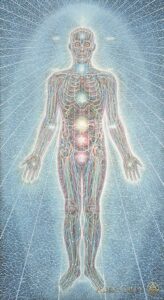
The subtle body system, by artist Alex Grey, showing the 7 major chakras and the meridians.
In a Crestone and Beyond writing posted on May 13, 2009, entitled Names of Light Body…A Bibliography, I listed some of the names of the subtle energy system from various cultures and spiritual paths. A listing of book references is given for further reading on this vast and engaging subject.
The human body is a fascinating wonder and miracle.
A Sufi sage and poet once said, “Thinkest thouself a puny form when within thee the whole Universe is enfolded.”
One uncommon interpretation of the word “human” breaks the word down into “hue” and “man.” The syllable hue refers to light. Man refers to mind. We are beings of light, or, electromagnetic energy. The entire human body is an electromagnetic phenomenon working through its biochemistry to sustain the physical form which carries that spirit.
It is said by all of the great spiritual sages that to have a human birth is the rarest of blessings, and is certainly the most cherished of all.
I now own 3 copies of The Human Body, What It I and How It Works.
I regard this text as one of the best writings on the planet. I may spring for more copies to be able to one day give as gifts.
Thanks for reading.
Signing off from Crestone and Beyond
Associated Readings
- The Spiral of Life…Heart Electromagnetics, Part II…a writing on this website which is my favorite writing, and seems to get the most visits by readers. The muscular anatomy of the heart, known as the helical ventricular myocardial band, the HVMB, is described. This muscular configuration helps make possible our heart’s subtle communication with the interpenetrating energy fields of Creation.
- Prayer…one very special way we connect to Creation.
- Minding your Meditation…the how-to and benefits of meditation are explained. At the end of the reading list is a description of Dr. Andrew Weil’s 4-7-8 breath technique for activating vagus nerve tone and calming the body.
- Heart Based Consciousness…some autobiography about how I learned about the wider functions of the heart.
- Diving Reflex: A Powerful Way to Enhance Vagal Tone–Here’s How to Activate It…posted here on 4-15-26. “The diving reflex is an automatic physiological response triggered when you immerse your face in cold water or hold your breath. It can have fascinating and practical effects—slowing the heart, conserving oxygen, and even calming the body.”
- Understanding the Foundations of Health…posted here on 4-19-26. It is good to learn about your human body and its miraculous healing intelligence, which I call the Divine Healing Intelligence, or, the DHI. This Mercola article poses some encouragement for us to become empowered about and accountable to our body. The main points of the article are: “In my interview with Dr. Patrick Gentempo, we discussed how true health care involves developing self-trust and personal judgment rather than blindly following medical authorities. Understanding your body’s natural healing abilities helps make informed decisions about treatments and interventions…While emergency medical care is vital for acute conditions, the current health care system often emphasizes crisis management and quick fixes rather than promoting everyday wellness and prevention…Fear disrupts self-trust and decision-making in health care choices. Developing a personal health philosophy helps you evaluate treatments based on evidence and individual experience rather than external pressure…Your body’s cellular energy production, particularly through mitochondrial health, plays a key role in overall wellness. Avoiding toxins and making lifestyle changes significantly improves natural healing capacity…Making health decisions should combine logical analysis of scientific evidence with intuitive understanding of your body. Small, consistent changes in daily habits often lead to significant health improvements.”