Because these 2 prior articles on this subject were somewhat long and detailed, this Journal entry will be a shorter extension of this earlier posted information about the EGX. The focus in this Journal will be on a 2018 research article which develops information about the all important contribution of the EGX to cerebral circulation.
This research has highlighted the role of the endothelial glycocalyx in supporting the blood-brain barrier, brain health, and overall brain resilience. Research indicates that the glycocalyx may be one of the most overlooked yet critical protectors of the brain. Insomuch as the EGX is the foundational key to vascular health, it is exciting to see recent research that points to its importance for blood-brain barrier health.
A report by 22 Japanese researchers appeared in the November 30, 2018 edition of Scientific Reports, entitled “Brain-Specific Ultrastructure of Capillary Endothelial Glycocalyx and Its Possible Contribution for Blood Brain Barrier”. This research article indicates that there is more glycocalyx in the capillaries that serve the brain than in any other organs, including the heart and lungs.
Quoting from the authors’ opening statements…”We found that endothelial glycocalyx is present over the entire luminal surface of cerebral capillaries. The percent area physically covered by glycocalyx within the lumen of cerebral capillaries was 40.1 ± 4.5%, which is significantly more than in cardiac and pulmonary capillaries (15.1 ± 3.7% and 3.7 ± 0.3%, respectively). Upon lipopolysaccharide-induced vascular injury, the endothelial glycocalyx was reduced within cerebral capillaries, but substantial amounts remained. By contrast, cardiac and pulmonary capillaries became nearly devoid of glycocalyx. These findings suggest the denser structure of glycocalyx in the brain is associated with endothelial protection and may be an important component of the blood brain barrier.”
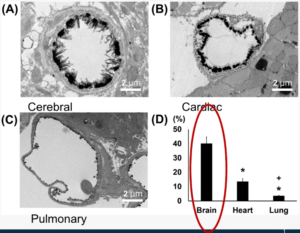
Transmission electron microscopic analysis of continuous capillaries. Cerebral (A), cardiac (B) and pulmonary (C) capillaries with lanthanum nitrate staining. The endothelial glycocalyx covers the surface of vascular endothelial cells. (D) Percent area covered by endothelial glycocalyx in capillaries of brain, heart and lung.
Why does the brain need more endothelial glycocalyx?
One of the glycocalyx’s primary roles throughout the body is to act as the protector of the blood vessel system. The endothelial glycocalyx in the brain is the critical component of the blood-brain barrier, and acts as a selective filter to regulate the exchange of substances between the bloodstream and the brain.
The cerebral EGX protects neural tissues, including neurons and glial cells, which are integral to the central nervous system’s ability to process and transmit information, supporting everything from basic motor skills to complex cognitive activities.
Three papers have been published recently about the critical role of the EGX in brain health:
- The “endothelial glycocalyx is crucial for maintaining brain homeostasis.” – Ando et al., 2018, “Brain-Specific Ultrastructure of Capillary Endothelial Glycocalyx and Its Possible Contribution for Blood Brain Barrier.” Nature’s Scientific Reports
- “Glycocalyx dysregulation impairs blood–brain barrier in ageing and disease” – Title of Shi et al., 2025, Nature
- “Rhamnan Sulfate from the Seaweed Monostroma nitidum May Improve Cognitive Impairment Caused by Hyperglycemia” – Miwa 2025, Preprint
As more research emerges, the role of the endothelial glycocalyx (EGX) in blood-brain barrier health is becoming clearer. Protecting this vital structure may be an important strategy for optimizing long-term neurological function.
Glycocalyx Regenerating Compounds
Here is an extended quote from the earlier Journal, Blood Vessel Health, Part I, explaining the efficacy of rhamnan sulfate, an extract from the seaweed Monostroma nitidum, which is the principle agent in the new supplement Arterosil HP, from Designs for Health.
“A new therapeutic clinical practice has developed around the biochemistry of a class of compounds known as glycocalyx regenerating compounds, also called GRCs. The new bioactive GRC compound which has demonstrated the highest degree of efficacy in regenerating and maintaining a healthy EGX is a chemical known as rhamnan sulfate (RS), which is extracted from the seaweed Monostratum nitidum.
Rhamnan sulfate is currently the only substance known which creates such dramatic improvement in the EGX.
Arterosil HP is the world’s first GRC dietary supplement. It has received a patent award for being able to stabilize and regress vulnerable soft plaque. Over the past 20 years numerous cellular, animal and human studies have been conducted to evaluate the biological activities, mechanism of action, and the health benefits of rhamnan sulfate.
RS is the principal component of Arterosil HP. Other synergistic GRC vasculo-protective ingredients included in this formula are: grape seed extract, green tea extract, grape pulp, tomato, carrot root juice, bilberry, broccoli, green cabbage, onion, garlic, grapefruit, asparagus, papaya, pineapple, strawberry, apple, apricot, cherry, orange, blackcurrant, olive extract, and cucumber.
Rhamnan sulfate works because it provides bioactive sulfated polysaccharides to nourish the delicate projections of the EGX. These carbohydrate based polysaccharides act as building blocks for the hair like EGX branches which contain various glycoproteins, proteoglycans, and glycosaminoglycan constituents. By supporting the repair and regeneration of the endothelial glycocalyx, Arterosil HP supports the structure and the normal function (form and function) of the endothelial glycocalyx, the underlying endothelium, and the deeper vessel wall.
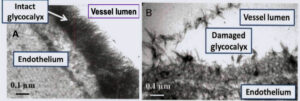
RS has been well studied for its cardiovascular health benefits for the past 20 years. In human and animal studies, RS has demonstrated EGX regenerative ability as well as independent beneficial effects on hypercholesterolemia, hyperglycemia, hypertension, obesity, and inflammation. Such information is referenced in detail in the technical writing and references which follow the Associated Reading references below.”
Summary
The brain has a highly specialized and delicate vascular interface, the most important component of which is the endothelial glycocalyx. This biologically active structure governs what has been known as the blood-brain barrier. The integrity and functional health of the EGX is perhaps the most important first consideration to consider in brain health.
Arterosil HP is a new supplement which serves as an effective glycocalyx regenerating compound. I covered Arterosil HP in some detail at the end of Blood Vessel Health, Part I, and I refer the reader to that summary.
Signing off from Crestone and Beyond
Additional Reading
I have written a collection of Journals on brain health which can be seen at these links on the website:
- Brain Health
- Brain Health and the Degenerative Disease Spectrum
- Blood Sugar and Brain Health
- Brain Health Nutrients
- The Present Moment, a Brain Health Journal
- Brain Wash
- Neurodegeneration…New Perspectives
In addition, there are other Journal writings on subjects which support brain health:
- Blood Vessel Health, Part I
- Blood Vessel Health, Part II
- Vitamin D
- Anti-Aging
- The Ketogenic Diet
- Minding your Methylation
- Minding your Meditation
- Minding your Mind
Associated Readings…Here are additional related articles from some sources I read.
- Scientists Discover a Previously Unknown Cognitive Benefit of Aerobic Exercise…posted here on 10-16-26. “A single session of moderate aerobic exercise helped preserve the brain’s automatic ability to adjust movements when sensory feedback didn’t match expectations…Exercise supports neuroplasticity through several pathways, including BDNF, a protein involved in strengthening and reorganizing connections between brain cells…Aerobic exercise, strength training, combined training, mind-body exercise and other forms of activity increased BDNF, while harder exercise didn’t necessarily produce greater increases…Consistency matters: BDNF responses increased during the early weeks of regular exercise and peaked at approximately eight to 20 weeks, with favorable responses continuing during longer programs…In children, higher aerobic fitness was associated with better inhibitory control, suggesting that physical fitness is linked to the brain’s ability to stop an automatic response and resist distractions.”
- Study Links Microplastics in Arterial Plaque to Fourfold Increase in Stroke Risk…posted here on 7-6-26. “Human brain tissue contains far higher concentrations of microplastics than liver or kidney tissue, and researchers found the burden increased sharply between 2016 and 2024…Researchers discovered that patients with microplastics embedded inside carotid artery plaque faced a 4.53-fold higher risk of heart attack, stroke, or death compared to patients without detectable plastics in plaque…Studies found plastic particles inside blood clots and diseased artery walls, while animal experiments showed nanosized plastics disrupting blood flow and worsening brain injury after stroke…Ultraprocessed foods, bottled beverages, plastic packaging, contaminated water, and airborne particles expose your body to microplastics daily, allowing the burden to build gradually inside tissues and blood vessels…Reducing ultraprocessed foods, avoiding heated plastic containers, filtering drinking water, and improving metabolic and vascular health help lower ongoing exposure and support your body’s defenses against chronic inflammatory damage.”
- A Ministroke Has Major Consequences…posted here on 5-15-26. “A ministroke, or transient ischemic attack (TIA), is your brain’s urgent warning sign that a full-blown stroke could strike within hours or days — up to 20% of people have a major stroke within 90 days, and half of those happen within just 48 hours…TIA symptoms mimic those of a stroke but disappear quickly, which often leads people to ignore them — a dangerous mistake that leaves you vulnerable to permanent brain damage and disability…Even if a TIA leaves no trace on an MRI, research shows it causes long-term cognitive decline similar to a full stroke, especially in memory and language processing…Lifestyle habits like smoking, poor diet, and unmanaged chronic conditions such as high blood pressure or atrial fibrillation dramatically raise your risk for both TIAs and major strokes, but you can reverse those risks with the right changes…Acting quickly if symptoms appear, leading a healthy lifestyle, training your brain and using each follow-up as a whole-body check-in are your best tools to prevent a second event and preserve your mental sharpness over time.”
- The Role of Strength and Resistance Training in Stroke Recovery and Healthy Aging…posted here on 3-16-26. Main points here: “Over 795,000 people in the U.S. have a stroke each year, and more than half of the survivors are aged 65 and older…An animal study published in MedComm found that low-intensity exercise helped mitochondria from muscles travel to the brain, supporting repair after stroke and in vascular dementia models…Sarcopenia, the age-related loss of muscle mass and strength, is driven by reduced responsiveness to protein and exercise signals, not aging alone…Resistance training and strength training aren’t the same; resistance training uses any opposing force, while strength training focuses on progressively heavier load…Simple habits amplify exercise benefits, including adequate protein intake, reduced sedentary time, safe sun exposure, healthier fat choices, and short, consistent training sessions rather than excessive workouts.”
- How to Optimize Your Recovery After a Stroke…posted here on 1-25-26. A former stroke victim explains how to invoke and enhance neuroplasticity in stroke recovery. The main points covered here are: “Ischemic strokes can be effectively treated within a three-hour window; thrombolytic drugs can be administered that dissolve the blockage, preventing further damage to your brain…Following a stroke, it’s important to engage your neuroplasticity to regain lost function. Stroke of Luck: Master Neuroplasticity for Recovery and Growth After Stroke is an important reference guide for doctors and patients…Brain training and physical exercises allow your brain to develop alternate pathways to bypass the damaged area; the sooner you do it after the damage has been incurred, the more effective it will be…An estimated 795,000 strokes occur each year in the U.S. It’s the fifth leading cause of death, killing an estimated 129,000 annually…Strokes are becoming more prevalent in younger people. An estimated 10% of all strokes occur in people under the age of 50.”
- Huge Study Links 99% of Heart Attacks and Strokes with 4 Risk Factors…posted here on 3-14-26. “A large international study found that 99% of heart attacks, strokes, and heart failure cases were preceded by at least one measurable risk factor, meaning these events are rarely random and often develop over years…High blood pressure was present in more than 93% of people before their cardiovascular event, making it the most common, and powerful warning sign you can monitor and correct early…Most individuals had two or more risk factors before their first event, showing that elevated blood pressure, blood sugar, imbalanced cholesterol, and smoking exposure stack together to accelerate arterial damage…Total cholesterol alone does not accurately reflect your true heart risk; markers like HOMA-IR, fasting insulin, triglyceride-to-HDL ratio, and iron levels provide a clearer picture of metabolic stress driving vascular disease…Addressing root causes — improving insulin sensitivity, eliminating seed oils, building muscle, walking daily and optimizing sunlight exposure — strengthens cellular energy production, and helps protect your arteries long before crisis strikes.”
- Gum Disease and Cavities Strongly Linked to Higher Stroke Risk…posted here on 12-16-25. The main points of this article are: “People with both gum disease and cavities have nearly double the risk of suffering an ischemic stroke compared to those with healthy teeth and gums…Chronic oral inflammation allows harmful bacteria and toxins to enter your bloodstream, damaging arteries and increasing blood clot formation that blocks blood flow to your brain…MRI brain scans show that gum disease alone causes silent brain injuries known as white matter lesions, which are early signs of stroke and cognitive decline…Regular cleanings, good oral hygiene, and biological dental care dramatically reduce stroke risk by preventing infection, lowering inflammation, and protecting the health of blood vessels…Healing your mouth through better nutrition, natural oral care, and toxin-free dentistry strengthens your gums, restores circulation, and supports long-term brain and heart health.”
- Reversing Alzheimer’s: The Forgotten Causes and Cures Big Pharma Buried…posted here on 12-14-25. This important contribution is from The Midwestern Doctor. “Due to Alzheimer’s research focusing on a symptom of it (amyloid plaques), rather than its actual cause, Alzheimer’s has remained ‘incurable’ for decades…Rather than being a single disease, Alzheimer’s has multiple different subtypes (e.g., those due to insulin resistance, nutritional deficiencies, inflammation, infections, or concussions), each of which requires a different treatments.” Please read on
- Science Finds Your Brain and Judgment Peak Around Age 60…posted here on 11-23-25. Main points here: “New research shows that overall human performance — combining intelligence, emotional balance, and judgment — peaks between ages 55 and 60, making midlife a time of strength, not decline…While mental processing speed slows with age, emotional intelligence, wisdom, and decision-making power continue to grow, helping you handle stress and relationships more effectively…Your brain adapts by strengthening networks that regulate emotion and memory, allowing smoother coordination between thought and feeling for wiser, more integrated choices…Eliminating seed oils high in linoleic acid (LA) and eating about 250 grams of healthy carbohydrates daily supports cellular energy and protects brain function…Staying physically active, prioritizing sleep, and pursuing lifelong learning help maintain focus, clarity, and vitality — proving that your 50s and 60s can be your most productive, fulfilling decades.”
- Rethinking Cardiovascular Disease Treatment Methods…posted here on 10-5-25. Main points of this article include: “Current treatments for heart disease fail to address root causes. Stents and bypass surgery only restore blood flow temporarily without tackling underlying endothelial dysfunction and inflammation driving heart disease…Despite their ability to lower cholesterol, statins have limitations. While these drugs lower LDL cholesterol by 25% to 35%, they don’t address oxidative damage or rebuild vessel health, leaving underlying inflammatory processes unchanged…Excess linoleic acid (LA) from vegetable oils fuels heart disease. Modern diets contain 7.2% LA, as opposed to 2.8% a century ago. This creates mitochondrial dysfunction and dangerous oxidized LDL cholesterol formation…Reducing LA intake shows measurable cardiovascular benefits. Limiting LA to under 5 grams daily reduces inflammatory markers like hsCRP by 15% and IL-6 by 10% within weeks…Novel approaches like nanoparticle chelation show promise. Targeted delivery systems can address calcified plaques directly, offering more precise treatment than traditional intravenous methods at lower costs.”
- Zone 2 Training Builds Endurance and Supports Long Term Fitness Without Burnout…posted here on 8-15-25. To estimate your target Zone 2 range, subtract your age from 220, then multiply that number by 0.6 and 0.7. For women, use 206 – (0.88 x your age) for a more accurate maximum. If you can speak in short phrases but need to pause for breath, you’re likely in the right zone. High points of this article: “Zone 2 training helps your body burn fat more efficiently while protecting your muscles, brain, and bones from the damaging effects of stress hormones like cortisol…This low-to-moderate intensity exercise zone builds endurance, improves mitochondrial function, and enhances oxygen delivery without exhausting your body…Unlike high-intensity workouts that cause fatigue, inflammation, and injury, Zone 2 lets you train consistently, recover faster and avoid burnout…Regular Zone 2 activity strengthens your cardiovascular system, lowers blood pressure and increases insulin sensitivity, all without needing extreme effort…To get the benefits of Zone 2, engage in daily activities like walking, hiking, or cycling as long as your heart rate stays within the target range.”
- How Tackling 5 Heart Risks by 50 Could Buy You a Decade More of Life…the points made in this article about heart health directly apply to brain health. Here are some main points of this article: “Five major heart risk factors at age 50 (high blood pressure, imbalanced cholesterol, diabetes, obesity and smoking) reduce your lifespan by more than a decade…People with none of these risk factors lived significantly longer and had more disease-free years — women gained 14.5 years and men 11.8 years…Linoleic acid from vegetable oils damages mitochondrial function and is a hidden root cause of cardiovascular problems that should be largely eliminated from your diet…Addressing even one risk factor in your 50s adds years to your life; lowering high blood pressure and quitting smoking offered the greatest benefits in the study…Beyond avoiding vegetable oils, healthy carb consumption, daily walking and regular sunlight exposure help restore cellular energy production and metabolic health.”
- Regular Exercise Boosts Memory and Brain Function at Any Age…”Cognitive decline is on the rise among Americans of all ages, leading to memory loss, trouble focusing, and poor decision-making. Regular physical activity significantly improves brain function, memory, and attention at any age…Engaging in moderate-intensity exercises like yoga, dancing, or even exercise-based video games enhances memory and decision-making skills, without the need for intense workouts…Brief, daily sessions of lighter exercise have shown greater cognitive benefits than longer, more strenuous routines, especially for children, adolescents, and individuals diagnosed with attention-deficit/hyperactivity disorder (ADHD)…Exercising outdoors further amplifies these benefits, significantly reducing mental fatigue, boosting creativity by up to 60%, and promoting emotional well-being by lowering stress and anxiety…Combining regular physical activity with quality sleep strengthens memory, attention, and overall cognitive sharpness, providing a powerful, practical strategy for keeping your brain healthy throughout your life.”
Technical References
This is a sampling of the more than 1100 articles on the subject of the EGX and glycocalyx regenerating compounds.
You can copy and search these references.
1. Reitsma S, Slaaf DW, Vink H, van Zandvoort MA, oude Egbrink MG. The endothelial glycocalyx: composition, functions, and visualization. Pflugers Arch. 2007;454(3):345‑359. doi:10.1007/s00424‑007‑0212‑8.
2. Bai K, Wang W. Spatio‑temporal development of the endothelial glycocalyx layer and its mechanical property in vitro. J R Soc Interface. 2012;9(74):2290‑2298. doi:10.1098/rsif.2011.0901.
3. Tarbell JM, Cancel LM. The glycocalyx and its significance in human medicine. J Intern Med. 2016;280(1):97‑113.
doi:10.1111/joim.1246.
4. Nitenberg A, Cosson E, Pham I. Postprandial endothelial dysfunction: role of glucose, lipids and insulin. Diabetes
Metab. 2006;32(suppl 2):2S28‑2S33. doi:10.1016/s1262‑3636(06)70482‑7.
5. Machin DR, Bloom SI, Campbell RA, et al. Advanced age results in a diminished endothelial glycocalyx. Am J Physiol
Heart Circ Physiol. 2018;315(3):H531‑H539. doi:10.1152/ajpheart.00104.2018.
6. Machin DR, Phuong TT, Donato AJ. The role of the endothelial glycocalyx in advanced age and cardiovascular disease. Curr Opin Pharmacol. 2019;45:66‑71. doi:10.1016/j.coph.2019.04.011.
7. Kolářová H, Ambrůzová B, Svihálková Šindlerová L, Klinke A, Kubala L. Modulation of endothelial glycocalyx structure under inflammatory conditions. Mediators Inflamm. 2014;2014:694312. doi:10.1155/2014/694312.
8. Constantinescu A, Spaan JA, Arkenbout EK, Vink H, Vanteeffelen JW. Degradation of the endothelial glycocalyx is
associated with chylomicron leakage in mouse cremaster muscle microcirculation. Thromb Haemost. 2011;105(5):790‑801. doi:10.1160/TH10‑08‑0560.
9. Lipowsky HH. The endothelial glycocalyx as a barrier to leukocyte adhesion and its mediation by extracellular
proteases. Ann Biomed Eng. 2012;40(4):840‑848. doi:10.1007/s10439‑011‑0427‑x.
10. Weinbaum S, Tarbell JM, Damiano ER. The structure and function of the endothelial glycocalyx layer. Annu Rev
Biomed Eng. 2007;9:121‑167. doi:10.1146/annurev.bioeng.9.060906.151959.
11. Curry FR, Adamson RH. Vascular permeability modulation at the cell, microvessel, or whole organ level: towards
closing gaps in our knowledge. Cardiovasc Res. 2010;87(2):218‑229. doi:10.1093/cvr/cvq115.
12. Curry FE, Adamson RH. Endothelial glycocalyx: permeability barrier and mechanosensor. Ann Biomed Eng.
2012;40(4):828‑839. doi:10.1007/s10439‑011‑0429‑8.
13. Moore KH, Murphy HA, George EM. The glycocalyx: a central regulator of vascular function. Am J Physiol Regul Integr Comp Physiol. 2021;320(4):R508‑R518. doi:10.1152/ajpregu.00340.2020.
14. Banerjee S, Mwangi JG, Stanley TK, Mitra R, Ebong EE. Regeneration and assessment of the endothelial glycocalyx to address cardiovascular disease. Ind Eng Chem Res. 2021;60(48):1732817347. doi:10.1021/acs.iecr.1c03074.
15. Harada N, Maeda M. Chemical structure of antithrombin‑active Rhamnan sulfate from Monostrom nitidum. Biosci Biotechnol Biochem. 1998;62(9):1647‑1652. doi:10.1271/bbb.62.1647.
16. Bruce D. Rhamnan sulphate composition for treatment of endothelial dysfunction. United States Patent, 6797705. 2004.
17. Maeda M, Uehara T, Harada N, Sekiguchi M, Hiraoka A. Heparinoid‑active sulphated polysaccharides from Monostroma nitidum and their distribution in the chlorophyta. Phytochemistry. 1991;30(11):3611‑3614.
doi:10.1016/0031‑9422(91)80076‑D
18. Mao W, Fang F, Li H, et al. Heparinoid‑active two sulfated polysaccharides isolated from marine green algae
Monostroma nitidum. Carb Pol. 2008;74(4):834‑839. doi:10.1016/j.carbpol.2008.04.041.
19. Li H, Mao W, Zhang X, et al. Structural characterization of an anticoagulant‑active sulfated polysaccharide isolated from green alga Monostroma latissimum. Carb Pol. 2011;85(2):394‑400. doi:10.1016/j.carbpol.2011.02.042.
20. Liu X, Du P, Liu X, et al. Anticoagulant properties of a green algal rhamnan‑type sulfated polysaccharide and its
low‑molecular‑weight fragments prepared by mild acid degradation. Mar Drugs. 2018;16(11):445.
doi:10.3390/md16110445.
21. Liu X, Hao J, He X, et al. A rhamnan‑type sulfated polysaccharide with novel structure from Monostroma angicava Kjellm (Chlorophyta) and its bioactivity. Carbohydr Polym. 2017;173:732‑748. doi:10.1016/j.carbpol.2017.06.031.
22. Liu X, Wang S, Cao S, et al. Structural characteristics and anticoagulant property in vitro and in vivo of a seaweed
sulfated rhamnan. Mar Drugs. 2018;16(7):243. doi:10.3390/md16070243.
23. Li H, Mao W, Hou Y, et al. Preparation, structure and anticoagulant activity of a low molecular weight fraction
produced by mild acid hydrolysis of sulfated rhamnan from Monostroma latissimum. Bior Tech. 2012;114:414‑418.
doi:10.1016/j.biortech.2012.03.025
24. Li N, Liu X, He X, et al. Structure and anticoagulant property of a sulfated polysaccharide isolated from the green
seaweed Monostroma angicava. Carbohydr Polym. 2017;159:195‑206. doi:10.1016/j.carbpol.2016.12.013.
25. Okamoto T, Akita N, Terasawa M, Hayashi T, Suzuki K. Rhamnan sulfate extracted from Monostroma nitidum
attenuates blood coagulation and inflammation of vascular endothelial cells. J Nat Med. 2019;73(3):614‑619.
doi:10.1007/s11418‑019‑01289‑5.
26. DeSilva D, Gladden J, Chen C, Ward J. The role of the endothelial glycocalyx in the pathogenesis of atherosclerosis: a new frontier in cardiovascular health. A4M article. V11‑0‑20‑16. 2016. https://arterosil.com/documents/role‑of‑the‑endothelial‑glycocalyx‑in‑the‑pathogenesis‑of‑atherosclerosis.pdf.
27. Nishikawa M, Mitsui M, Umeda K, Kitaoka Y, Takahashi Y, Tanaka S. Effect of sulfated polysaccharides extract from sea algae (Monostroma Latissium and Monostroma Nitidum) on serum cholesterol in subjects with borderline or mild hypercholesterolemia. J New Rem & Clin. 2016;55(11):95‑102.extension://efaidnbmnnnibpcajpcglclefindmkaj/http://tnhc.s3‑us‑west‑2.amazonaws.com/Arterosil‑Clinical%20Studies.pdf.
28. Kamimura Y, Hashiguchi K, Nagata Y. Inhibitory effects of edible green algae Monostroma nitidum on glycemic
responses. Nippon Shokuhin Kagaku Kogaku Kaishi. 2012;57(10):441‑445. doi:10.31136/nskkk.57.441. https://www.
researchgate.net/publication/270399618_Inhibitory_Effects_of_Edible_Green_Algae_Monostroma_nitidum_on_
Glycemic_Responses.
29. Zang L, Shimada Y, Tanaka T, Nishimura N. Rhamnan sulphate from Monostroma nitidum attenuates hepatic steatosis by suppressing lipogenesis in a diet‑induced obesity zebrafish model. J Func Foods. 2015;17:364‑370.
doi:10.1016/j.jff.2015.05.041.
30. Okamoto T, Akita N, Terasawa M, Hayashi T, Suzuki K. Rhamnan sulfate extracted from Monostroma nitidum
attenuates blood coagulation and inflammation of vascular endothelial cells. J Nat Med. 2019;73(3):614‑619.
doi:10.1007/s11418‑019‑01289‑54.
31. Calroy Health Sciences, LLC. Arterosil & the Endothelial glycocalyx: overview of research studies to date. In Arterosil Artery Support, Science, C.H. Ed.: Scottsdale, AZ, 2019. https://arterosil.com/images/Arterosil_Research_Studies_final_singlepages.pdf.
32. Patil N, Gomez‑Hernandez A, Zhang F, et al. Rhamnan sulfate reduces atherosclerotic plaque formation and vascular inflammation. bioRxiv 2022. https://www.biorxiv.org/content/10.1101/2022.02.10.479785v1.full.pdf
33. Yamamoto Y, Ozono M, Oishi T, et al. Hyaluronidase‑inhibitory activity of Rhamnan sulfate obtained from cultivated monostroma nitidum (hitoegusa). Nippon Shokuhin Kagaku Kogaku Kaishi. 2016;63:545549. doi:10.3136/nskkk.63.545.
34. Constantinescu AA, Vink H, Spaan JA. Endothelial cell glycocalyx modulates immobilization of leukocytes at the
endothelial surface. Arterioscler Thromb Vasc Biol. 2003;23(9):1541‑1547. doi:10.1161/01.ATV.0000085630.24353.3D.
35. Jantan I, Haque MA, Arshad L, Harikrishnan H, Septama AW, Mohamed‑Hussein ZA. Dietary polyphenols suppress chronic inflammation by modulation of multiple inflammation‑associated cell signaling pathways. J Nutr Biochem. 2021;93:108634. doi:10.1016/j.jnutbio.2021.108634.
36. Parsamanesh N, Asghari A, Sardari S, et al. Resveratrol and endothelial function: a literature review. Pharmacol Res. 2021;170:105725. doi:10.1016/j.phrs.2021.105725.